
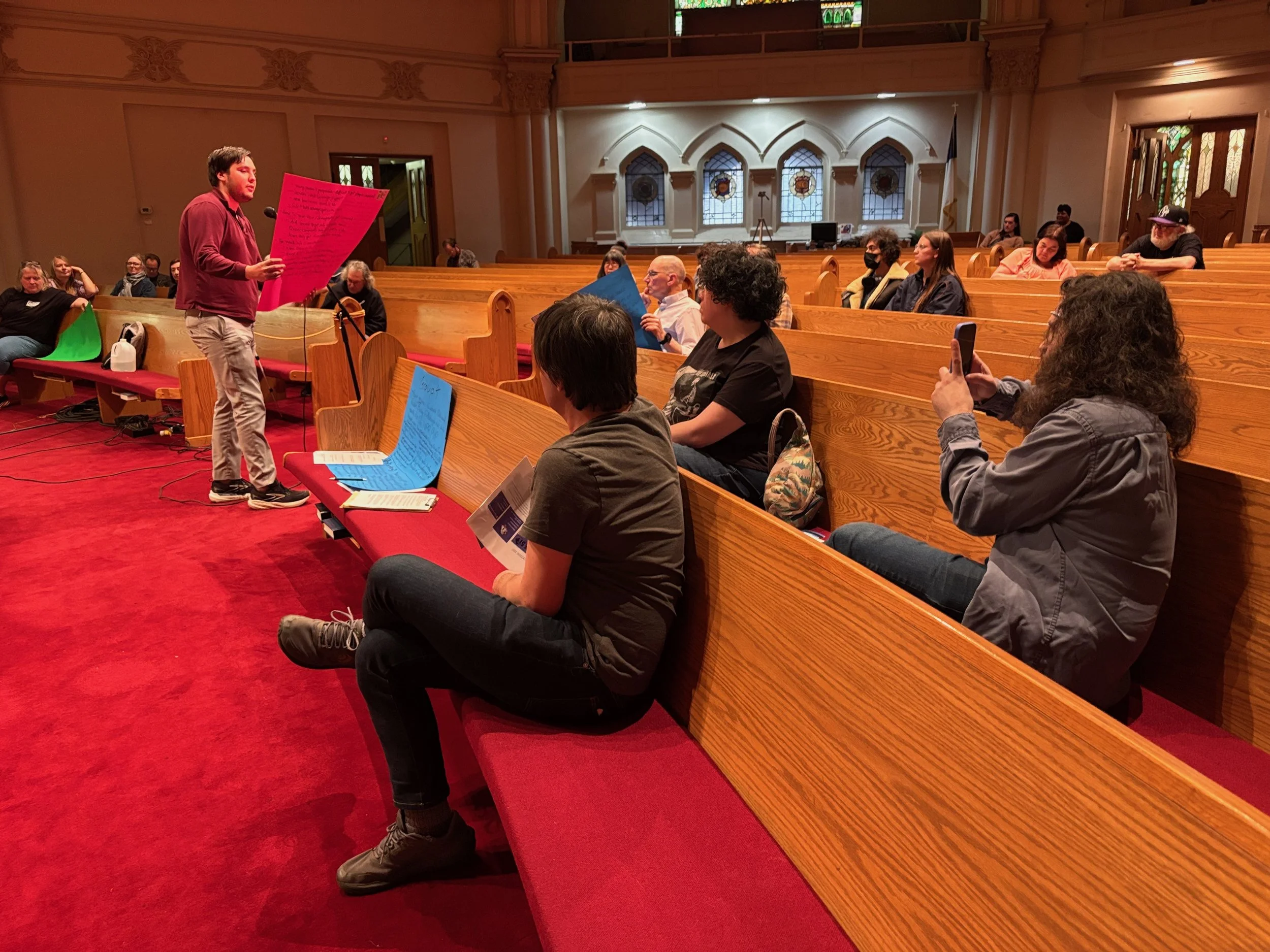
Participants discuss ideas about creating a cooperatively-owned news publication focusing on the concerns of working-class people at a town hall hosted by the Pittsburgh Alliance People-Empowered Reporting (PAPER) at the Homestead United Presbyterian Church in Homestead.
Photograph by Steve Mellon
When the nearly 240-year-old Pittsburgh Post-Gazette closed its doors on May 4, it left behind a community of readers who were stunned beyond belief and employees struggling for answers.
The owners of the newspaper, Block Communications, Inc., had launched a silent attack, in an answer to their employees’ grievances over health care, surety of a work week and restoring a contract. The Post Gazette even went so far as to take the matter to the U.S. Supreme Court. An appeal was made; however, the court denied the PG's attempt to suspend a health care ruling in favor of its striking employees.
The company dealt a fateful blow to the newspaper’s future on January 7, when it informed employees they were closing the publication during a two-minute video. Weary, faithful union journalists with many years of experience, who had struggled for three years to win the strike against Block Communications, saw their efforts go up in smoke.
Undaunted, former employees decided to form a new group called Pittsburgh Alliance for People-Empowered Reporting (PAPER) to explore the idea of starting a cooperatively-owned news publication focusing on the concerns of working-class people. At a meeting held on May 13, at the Homestead United Presbyterian Church in Homestead, former employees and people of the community gathered to contribute ideas and discuss plans to make this visionary project more of a reality. As an observer attending the meeting of the former PPG employees, I could sense the hurt among the former strikers. Many believed that they would not be able to continue writing.
PAPER’s efforts could offer writers, editors and photographers an opportunity to keep their craft in good working condition. As an organization owned by the members, a co-op news site would give voice to those directly involved with the reporting, editing and production end.
Aside from seeking funding without corporate interference or monies from billionaires who are seeking to wield power, PAPER has established a business plan, and explored various ways in which workers and co-op members could hold the publication accountable, and become involved in the decision-making process. The question is how a news organization can best represent the community and produce a product that is accurate, informative and entertaining.
Attendees shared their concerns in small round-table discussions and explained how they receive their news. Answers included YouTube videos, podcasts, newspaper subscriptions, local television, Public Source, NPR, New York Times to word-of-mouth, social media and announcements attached to telephone poles and cafeteria bulletin boards. Topics of interest that were discussed included schools, community events, local government, new businesses, investigations, road and bridge closures, water main breaks and church news.
The audience believed if more good news stories about communities and teens are covered, then news about crime and economically distressed areas would not stand out so much. “I live around nice working people, Blacks and Latinos. We want to publicize what is the heartbeat of the people,” said Rev. Denise Welsh, of the Pennsylvania Interfaith Network.
Minorities, ethnic and religious groups are often represented in a negative way, rather than showing the positive sides of diversity. “Misinformation can spread. Real voices of the residents are left out. Accountability is on the people who care about community,” said Homestead Mayor Mary Nesby.
Steve Mellon, a former Post-Gazette photographer and writer, who survived the three-year strike, remains hopeful. “It’s especially good to be here in Homestead and pushing back against monied bullies. The Homestead area has a history of coming together to fight,” said Mellon.
PAPER was born out of frustration over violated federal laws and labor laws. On May 4, the new owners of the non-profit Venetoulis Institute cut staff by 50 percent and got rid of most of the strikers. Many former strikers believe it was a union-busting move.
Yet, it was the spirit and the strength of the workers who withstood the longest strike ever in this region, despite the growing personal toll, that is enabling them to persevere.
Mellon stated that PAPER is finalizing a business plan for the worker- and community-owned publication, which will include a website and a new name. He said PAPER’s goal is to form an organization that listens to its readers' needs and concerns.
Paying contributors will continue to be important to the organizers. “We need people to engage in media,” he said Across the country, he added, private equity firms continue to buy newspapers and publish them with drastically reduced staffs or simply shut them down. “We need good trustworthy information,” said Mellon.
As the meeting ended, Mellon encouraged attendees to stay in touch. “We need to show investors community support, which takes several different forms , which includes town hall attendance and participation, direct involvement in the PAPER organization itself, letters of support and financial contributions.”
— Colette Funches